Carlyle joins list of possible Thames Water rescue backers | Business News

Carlyle, the American investment giant, has become the latest global fund to weigh an investment in Thames Water as the stricken utility races to avoid being nationalised.

Sky News has learnt that Carlyle, which has roughly $435bn in assets under management, is at the very preliminary stages of assessing whether an investment in Thames Water Utilities Limited (TWUL) would be viable.

Britain’s biggest water and wastewater company, which has about 16 million customers, is edging towards the brink of collapse after warning in recent days that its financial liquidity is set to expire months earlier than previously anticipated.

It has also seen its credit rating downgraded further into junk territory by two leading rating agencies.

Carlyle is one of a long list of prospective investors approached by Rothschild, the investment bank advising Thames Water’s board, as the utility scrambles to raise more than £3bn in the coming months.

This weekend, people close to the process confirmed that Carlyle had been approached but said it was “too early” to judge whether the firm might participate in a rescue deal through one or more of its funds.

Among the others sounded out by Rothschild are Brookfield, the Canadian investment giant, and Global Infrastructure Partners, which is now owned by BlackRock.

Many investors and industry analysts believe, however, that the Rothschild-led process is destined to fail given the massive financial restructuring which faces Thames Water.

The company has about £16bn in debt, with approximately £10bn of that accounted for by a group of 90 funds which have appointed Jefferies and Akin Gump to represent them.

That syndicate is now preparing its own rescue plan in the coming weeks, which is likely to include an enormous debt-for-equity swap that would wipe out the existing shareholders.

Thames Water’s future remains so shrouded in uncertainty because the industry watchdog, Ofwat, has rejected the company’s initial spending plans for the next five-year regulatory period.

The company is now engaged in discussions with Ofwat ahead of its final determination in December.

A bridging loan of about £1bn is being contemplated by some of Thames Water’s creditors, but some stakeholders remain sceptical that any new financing will be forthcoming without greater regulatory certainty.

“Until the lenders know what they are bridging to, the concern deepens that they risk throwing good money after bad,” said one fund.

TWUL’s board is said to have met in the last 48 hours to discuss the implications of its latest rating downgrades and impending liquidity shortfall.

One creditor said that Ofwat was expected to appoint an independent monitor next week to scrutinise the company’s progress against its turnaround plan.

Ofwat, which signalled in August that it would make such an appointment, declined to comment.

If new investment into Thames Water is not forthcoming before it runs out of cash, the government will have little choice but to sanction the temporary nationalisation of the company.

This would be done through a Special Administration Regime (SAR), a procedure tested only once before when Bulb Energy collapsed in 2021.

As part of its contingency planning for implementing a far-reaching restructuring, Thames Water has booked court dates in November to progress a rescue deal.

A source close to the company said that Thames Water “continues to look at all options for extending its liquidity and raising new equity”.

“Reserving court dates is sensible forward planning and a part of keeping all options open.”

Lovecrafts stitches up sale to US buyer Missouri Star Quilt Company | Business News

A British online crafts retailer which saw sales boom during COVID-19 lockdowns will this week strike a deal to sell itself to an American bidder.

Sky News understands that Lovecrafts, which counts some of the UK’s best-known technology funds among its backers, is on the verge of agreeing a takeover by Missouri Star Quilt Company.

The deal is understood to value Lovecrafts in the tens of millions of pounds.

Sources said it could be concluded as soon as the next couple of days, following months of negotiations.

It is said to represent a complementary fit for Missouri Star Quilt because there is little overlap in terms of the two companies’ existing focus.

Lovecrafts, which is chaired by the media veteran Sir Peter Bazalgette, drafted in Interpath Advisory to work on a sale earlier this year.

Sir Peter, who became chairman in 2018, is a former chairman of ITV and one of the most prominent figures in the British media industry.

Founded in 2012, Lovecrafts is backed by leading growth investors including Highland Ventures, Balderton Capital and Scottish Equity Partners.

Lovecrafts grew rapidly during the pandemic, with Britain’s series of lockdowns prompting large numbers of consumers to take up hobbies such as knitting and sewing.

Growth has stalled since then, however, with its main shareholders said to be unwilling to inject more money into the business.

In 2021, Lovecrafts raised nearly £16m, adding to funding worth well over £25m that it had secured since its launch.

Lovecrafts could not be reached for comment, while Interpath declined to comment.

Carlyle joins list of possible Thames Water rescue backers | Business News

Carlyle, the American investment giant, has become the latest global fund to weigh an investment in Thames Water as the stricken utility races to avoid being nationalised.

Sky News has learnt that Carlyle, which has roughly $435bn in assets under management, is at the very preliminary stages of assessing whether an investment in Thames Water Utilities Limited (TWUL) would be viable.

Britain’s biggest water and wastewater company, which has about 16 million customers, is edging towards the brink of collapse after warning in recent days that its financial liquidity is set to expire months earlier than previously anticipated.

It has also seen its credit rating downgraded further into junk territory by two leading rating agencies.

Carlyle is one of a long list of prospective investors approached by Rothschild, the investment bank advising Thames Water’s board, as the utility scrambles to raise more than £3bn in the coming months.

This weekend, people close to the process confirmed that Carlyle had been approached but said it was “too early” to judge whether the firm might participate in a rescue deal through one or more of its funds.

Among the others sounded out by Rothschild are Brookfield, the Canadian investment giant, and Global Infrastructure Partners, which is now owned by BlackRock.

Many investors and industry analysts believe, however, that the Rothschild-led process is destined to fail given the massive financial restructuring which faces Thames Water.

The company has about £16bn in debt, with approximately £10bn of that accounted for by a group of 90 funds which have appointed Jefferies and Akin Gump to represent them.

That syndicate is now preparing its own rescue plan in the coming weeks, which is likely to include an enormous debt-for-equity swap that would wipe out the existing shareholders.

Thames Water’s future remains so shrouded in uncertainty because the industry watchdog, Ofwat, has rejected the company’s initial spending plans for the next five-year regulatory period.

The company is now engaged in discussions with Ofwat ahead of its final determination in December.

A bridging loan of about £1bn is being contemplated by some of Thames Water’s creditors, but some stakeholders remain sceptical that any new financing will be forthcoming without greater regulatory certainty.

“Until the lenders know what they are bridging to, the concern deepens that they risk throwing good money after bad,” said one fund.

TWUL’s board is said to have met in the last 48 hours to discuss the implications of its latest rating downgrades and impending liquidity shortfall.

One creditor said that Ofwat was expected to appoint an independent monitor next week to scrutinise the company’s progress against its turnaround plan.

Ofwat, which signalled in August that it would make such an appointment, declined to comment.

If new investment into Thames Water is not forthcoming before it runs out of cash, the government will have little choice but to sanction the temporary nationalisation of the company.

This would be done through a Special Administration Regime (SAR), a procedure tested only once before when Bulb Energy collapsed in 2021.

As part of its contingency planning for implementing a far-reaching restructuring, Thames Water has booked court dates in November to progress a rescue deal.

A source close to the company said that Thames Water “continues to look at all options for extending its liquidity and raising new equity”.

“Reserving court dates is sensible forward planning and a part of keeping all options open.”
UK becomes first G7 nation to exit coal-fired power | Business News

The final coal-fired power station left in the UK will be shut down later on Monday amid the transition to renewable energy.

The closure of Uniper-owned Ratcliffe-on-Soar power station in Nottinghamshire will bring to an end a 142-year history of burning fossil fuel to produce electricity in the country.

The UK was the first, in 1882, to utilise coal for public power generation.

Money latest:
Top chef reveals his fried chicken recipe – and you can make it for cost of KFC

It will now be the first G7 nation to end its use as the void from gradual coal-fired closures has been filled by green alternatives including solar and offshore wind.

Coal accounted for around 80% of the country’s power needs in 1990 but has been phased out under efforts to combat climate change.

That transition, however, led by a continued dependence on volatile natural gas prices, has come at a cost with International Energy Agency figures showing the UK has the highest industrial power prices in the developed world.

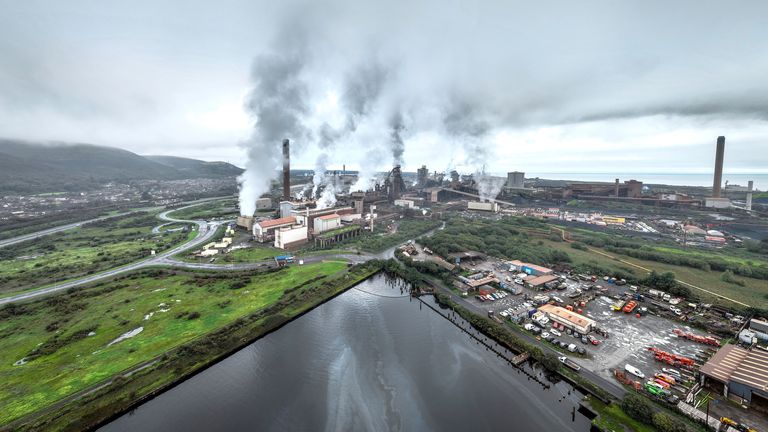
It explains the competitiveness problem within UK manufacturing and, pertinently, the end of production at the country’s largest virgin steelworks on Monday.

Ratcliffe-on-Soar has been the last coal-fired power station standing in the UK since September 2023.

Please use Chrome browser for a more accessible video player

2:55

Thousands of steelworkers to lose jobs
Such assets have been mainly held in reserve in recent years in case of generation challenges, such as a cold winter.

There were no coal-fired power plants paid to be on standby last year, compared to five in 2022/23.

Coal has accounted for less than 1% of UK generation in recent years though Ratcliffe was in use on Monday, providing 0.7% of the country’s electricity.

It has been generating power since 1968 and could provide enough electricity for two million homes.

It employs 170 staff.

Most will be kept on during the two-year decommissioning process.

Dhara Vyas, deputy chief executive of industry body Energy UK, said: “Ten years ago, coal was the leading source of this country’s power – generating a third of our electricity.

“So, to get to this point just a decade later, with coal’s contribution replaced by clean and low carbon sources, is an incredible achievement.

“As we aim for further ambitious targets in the energy transition, it’s worth remembering that few back then thought such a change at such a pace was possible.”

The Labour government is seeking to hit net zero emissions from electricity generation by 2030.

Please use Chrome browser for a more accessible video player

What is GB Energy and what will it do?

Its efforts to date have included a lifting of the de facto ban on onshore wind farms.

Energy minister Michael Shanks said: “Today’s closure at Ratcliffe marks the end of an era and coal workers can be rightly proud of their work powering our country for over 140 years. We owe generations a debt of gratitude as a country.

Read more from Sky News:
UK’s biggest steelworks to cease production
UK becomes first G7 nation to exit coal-fired power

“The era of coal might be ending, but a new age of good energy jobs for our country is just beginning. The government’s clean energy superpower mission is about creating good jobs in wind power and new technologies like carbon capture and storage.

“That work is helping boost our energy security and independence, protecting families from international hikes in the price of fossil fuels and with it, creating jobs and tackling climate change.”